What Is a Powered Hand and How Does It Work?
Losing hand function can make everyday tasks feel frustrating and limiting, and you’re not alone—many people struggle to find reliable support. A powered hand may offer the control, comfort, and confidence you need. In this roundup, we’ll explain what a powered hand is and how it works.
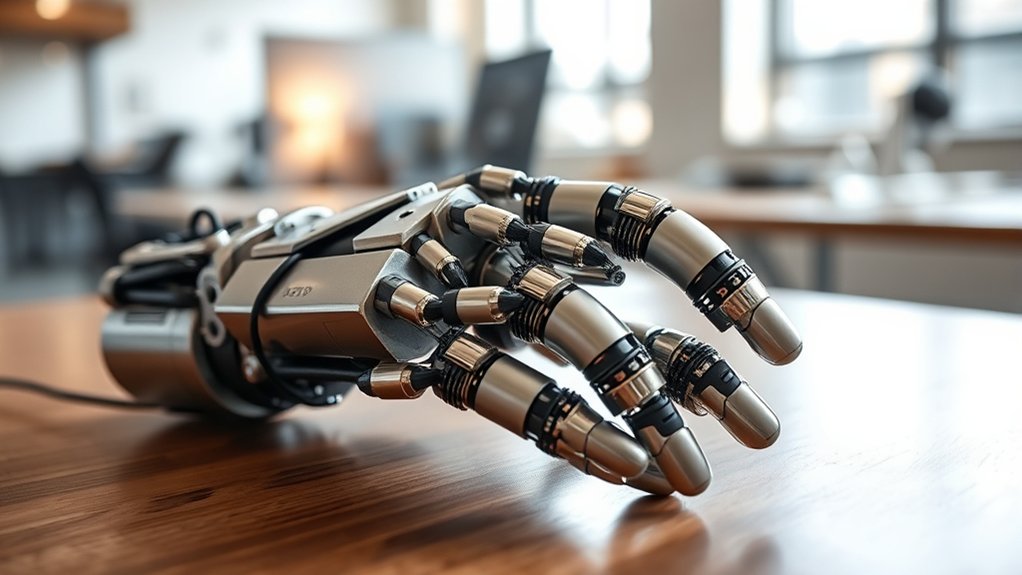
A powered hand is a motorized prosthesis that can help you replace or support lost hand function. Sensors detect your muscle signals, switches, or other commands, while a controller interprets your intent and activates motors inside the palm.
Gears and linkages then move the fingers and adjust grip strength for tasks such as pinching, holding, or lifting. Rechargeable batteries supply power, and practice helps you control movements more naturally.
You’ll uncover how its grips, fitting, and features support daily life.
Key Takeaways
- A powered hand is a motorized prosthetic device that replaces a missing hand or supports limited hand function.
- Sensors detect muscle signals, switches, or other user inputs and send commands to an onboard controller.
- The controller activates motors, gears, cables, and linkages to open, close, and position the fingers.
- Position and pressure sensors provide feedback, helping adjust grip strength, movement speed, and object handling.
- Powered hands support grips such as cylindrical, spherical, lateral, precision, tripod, and hook grips for daily tasks.
What Is a Powered Hand?
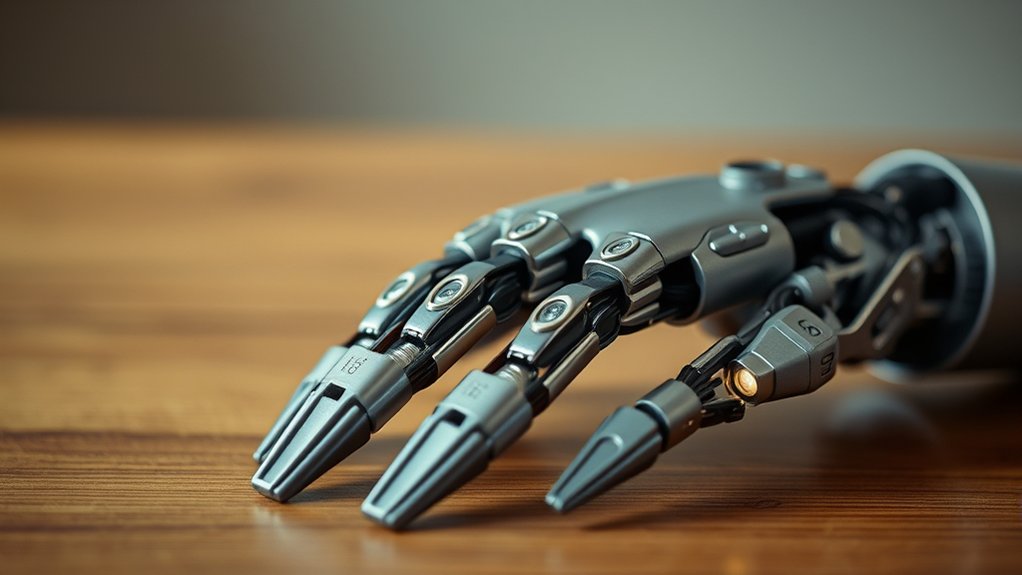
A powered hand is a prosthetic device that uses motors, sensors, and a battery to help you perform grasping and other hand movements. It can replace a missing hand or support limited function after injury, illness, or a congenital difference.
You control it through signals from your muscles, switches, or another interface, depending on the design. Unlike a passive prosthesis, it can actively open, close, and adjust its grip, helping you hold everyday objects more independently.
The hand may look realistic, mechanical, or customized for specific activities. Historical development has taken powered hands from bulky, limited devices to lighter systems with more natural movement and improved control.
Today, you can choose among different grip patterns, materials, and control methods based on your needs. Future innovations may deliver quieter operation, stronger feedback, greater durability, and more lifelike movement.
A powered hand doesn’t restore every natural ability, but it can expand your options and confidence in daily tasks.
What Parts Make a Powered Hand Move?
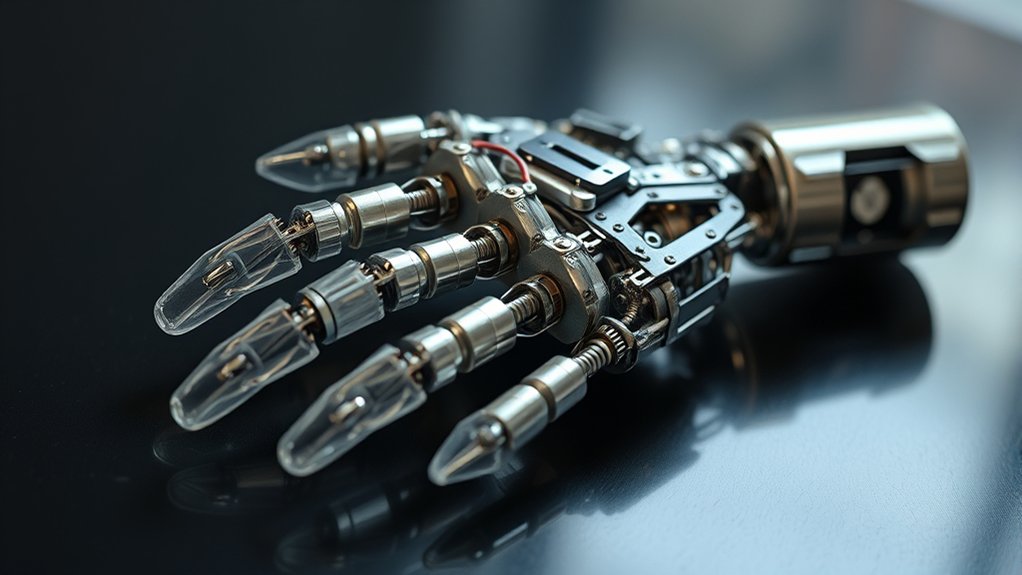
Your powered hand moves using motors and actuators that create precise finger and wrist movements. Sensors detect your muscle signals or the hand’s movement, and controllers interpret those signals to guide the motors. Working together, these parts help you control the hand smoothly and accurately.
Motors and Actuators
Motors and actuators turn electrical signals into the movements that open, close, and position a powered hand. A motor provides rotational force, while an actuator converts that force into controlled finger or thumb motion.
Depending on the design, gears, screws, cables, or linkages can multiply torque and guide each joint through its range. You’ll often find compact electric motors inside the palm, with separate mechanisms driving individual digits or groups of digits.
Efficient components help your hand perform useful tasks without draining its battery quickly, so regular battery maintenance supports consistent operation. Material durability matters, too: strong gears, shafts, housings, and connection points resist wear from repeated gripping.
When these parts work together, you get smooth, reliable movement and enough force to hold objects securely during everyday activities, work, or rehabilitation.
Sensors and Controllers
Sensors detect signals from your muscles or nerves, while controllers interpret those signals and direct the motors to move specific fingers or the thumb. Depending on your prosthetic design, sensors may read electrical muscle activity, pressure, or movement in your residual limb.
The controller converts each signal into commands, then adjusts motor speed and force for a natural response.
You can open, close, point, or grip by activating specific muscles or using another control method. Advanced systems filter accidental signals and coordinate several joints, helping you handle delicate objects without crushing them.
Settings support user customization, so a clinician can tune sensitivity, grip strength, and response timing to your needs.
As you gain experience, you’ll learn which muscle patterns produce each movement and refine your control through practice.
Regular maintenance keeps sensors aligned and controllers responsive.
What Happens When a Powered Hand Moves?
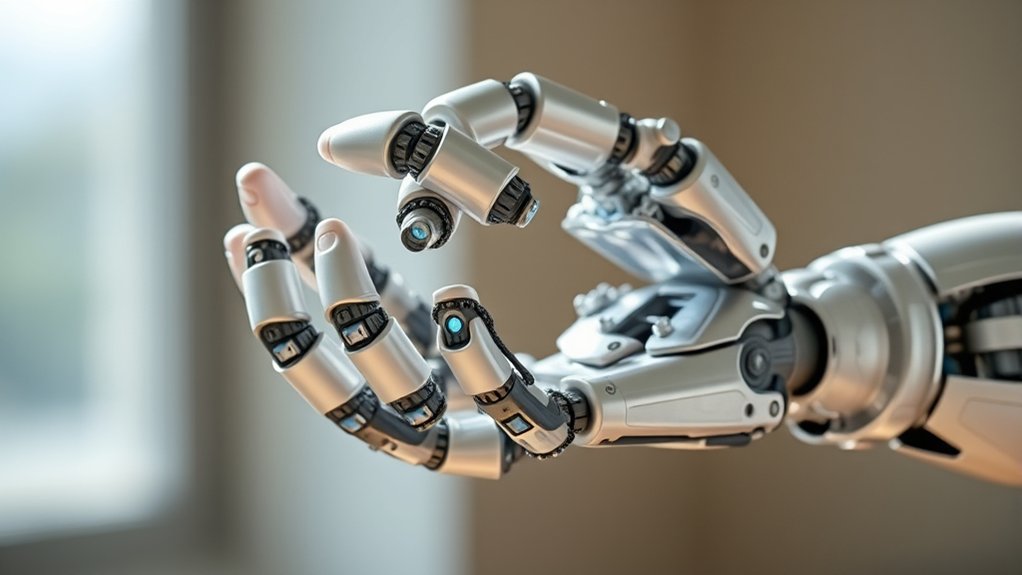
When you ask a powered hand to move, sensors detect your intended action and send signals to a controller. The controller interprets that command and activates small motors inside the hand. Gears, tendons, or linkages then transfer each motor’s force to the fingers, thumb, or wrist.
As a result, you can grasp, release, point, or reposition the hand with controlled, purposeful motion.
The system adjusts speed and force to match the task. It may close gently around a fragile cup or tighten its grip on a heavier object.
Position sensors track joint movement, helping the controller stop each motor at the right point. This feedback also supports smoother, more stable actions and helps prevent excessive force.
In robotic prosthetics, this process can restore useful hand functions after limb loss. In human augmentation, it can extend your natural abilities by providing extra strength, reach, or endurance.
You’ll still need practice, but repeated use can make these movements feel increasingly natural.
How Do Muscle Signals Control the Fingers?
Your powered hand picks up electrical signals from your muscles when you want to move a finger. These signals travel through your nerves, and the hand’s controller turns them into precise finger movements.
Muscle Signal Detection
Muscle signals control powered-hand fingers by translating your intended movement into electrical commands. When you contract a remaining limb muscle, sensors resting against your skin detect tiny electrical changes called myoelectric signals.
The hand’s control system filters and interprets these signals, then matches specific patterns with actions such as opening, closing, or pinching. You control movement by varying muscle activation, allowing the system to adjust speed or grip strength.
Reliable detection depends on consistent sensor contact, proper placement, and clean signal processing. During fitting, your clinician helps position electrodes and trains you to produce distinct contractions.
This process shapes prosthetic design while supporting user comfort. Sweat, movement, or loose components can weaken detection, so regular cleaning and secure positioning help maintain responsive finger control throughout daily activities.
Nerve-Controlled Finger Movement
Signals from your muscles guide the hand’s control system, which converts each contraction into a command for individual finger movements. When you intend to pinch, grasp, or point, nerve pathways carry coordinated instructions from your brain to the muscles that position each finger.
A powered hand interprets these patterns to recognize your intended action without requiring conscious control of every joint.
- Intent: You imagine the movement you want.
- Coordination: Nerve signals activate finger muscles in timed groups.
- Independence: Separate signal patterns support individual finger control.
- Refinement: Sensory feedback helps your nervous system adjust force and position.
This cooperation supports natural interaction and improves robotic dexterity. Although the hand’s electronics handle the response, your nervous system supplies the meaningful commands.
Consistent signals also help you perform familiar actions more smoothly and confidently.
Translating Signals Into Motion
As you attempt a movement, electrical activity in your residual muscles creates patterns that the powered hand’s sensors detect and interpret. Electrodes pick up these myoelectric signals through your skin and send them to the hand’s controller.
The controller filters noise, identifies your intended action, and activates the appropriate motors. For example, a signal from one muscle may initiate finger closing, while a different pattern opens the hand or adjusts grip strength.
Artificial intelligence can improve this process by learning your unique signal patterns and adapting as they change. With ergonomic design, the hand fits comfortably and responds naturally to your movements.
You’ll gain better control through practice because repeated use helps your brain and the device coordinate timing, force, and finger position for everyday tasks with greater confidence and precision.
What Grips Can a Powered Hand Perform?
A powered hand can perform several everyday grips, including a cylindrical grip for holding bottles, a spherical grip for grasping round objects, a lateral pinch for holding keys, and a precision pinch for picking up small items. You can use these grip patterns to handle common tasks with greater independence.
- Cylindrical grip: Wrap your fingers around cups, tools, or rails.
- Spherical grip: Secure apples, balls, and other rounded objects.
- Lateral pinch: Hold cards, paper, or keys between your thumb and finger.
- Precision pinch: Pick up coins, buttons, or small pieces without crushing them.
You may also benefit from tripod, hook, or open-palm positions for writing, carrying bags, and supporting objects. Advanced materials can help the fingers stay lightweight while maintaining strength and comfort.
Aesthetic designs can make the hand look more natural and fit your personal style. Your clinician or prosthetist can help you practice each grip and choose settings that match your routines, object sizes, and preferred level of control.
These options let you adapt your grasp to changing daily situations.
How Do Sensors Improve Grip Control?
Sensors improve grip control by detecting pressure, movement, and the position of your fingers, then helping the powered hand adjust its force. This feedback lets you hold delicate items without crushing them and secure heavier objects without slipping.
Sensors detect finger movement and pressure, helping powered hands adjust grip strength for safer, steadier control.
Pressure sensors measure contact at each fingertip, while motion sensors track how your fingers move. The system compares these signals with your intended action and responds within moments.
Accurate sensor calibration helps the hand interpret readings consistently. During calibration, you may open and close your fingers, touch different surfaces, or apply several levels of pressure.
These steps teach the controller how your movements relate to grip strength. If an object starts to slide, sensors can signal the motors to tighten the grasp.
If pressure rises too high, they can trigger a gentler response. You gain smoother, more natural control because the hand continuously adapts to changing objects, positions, and tasks while reducing unnecessary effort and improving confidence.
What Powers a Powered Hand?
Once sensors detect your intended movement, the powered hand needs a reliable energy source to move its motors. Most models use rechargeable lithium-ion batteries because they’re light, compact, and deliver steady power.
A control system regulates current, preventing sudden movements and protecting the battery from excessive drain.
Your hand’s runtime depends on motor strength, battery capacity, grip intensity, and how often you use it. Manufacturers typically design the battery to fit inside the hand or forearm, where you can remove, recharge, or replace it.
- Battery: Stores electrical energy for repeated use.
- Controller: Directs power to each motor.
- Motors: Convert electricity into finger movement.
- Charging system: Restores the battery safely.
Historical development brought improvements from heavy, short-lived battery packs to lighter, higher-capacity cells.
Today, smart power management extends operating time and provides battery-level feedback. Future innovations may include flexible batteries, faster charging, energy harvesting, and materials that store more power without increasing weight.
You’ll gain longer use between charges while preserving comfortable balance and control.
What Everyday Tasks Can It Handle?
A powered hand helps you grasp everyday household objects, such as cups, utensils, and door handles. It can also support personal-care activities, including brushing your teeth and grooming.
With practice, you can use it for many daily tasks, helping you become more independent.
Grasping Household Objects
A powered hand can help you grasp and move everyday items such as cups, utensils, clothing, and small tools. With adjustable grip strength, you can hold delicate objects gently or secure heavier items confidently.
Sensors may detect contact and help the fingers respond to changing shapes and surfaces, improving robotic dexterity.
You might use it to:
- Lift a mug without squeezing too tightly.
- Pick up a fork, spoon, or plate.
- Hold folded laundry while placing it away.
- Carry a screwdriver, remote, or gardening tool.
Simple controls, such as buttons, switches, or motion signals, let you choose how the hand closes and releases.
As assistive technology, it can reduce strain and support greater independence during household tasks. Performance varies by model, object size, weight, and battery life, so practice helps you build confidence.
Handling Personal Care
Beyond household objects, a powered hand can support personal care tasks such as holding a toothbrush, comb, razor, makeup tool, or toiletry bottle. You can select a suitable grip, adjust pressure, and position the tool near your body with greater control.
Sensors may detect contact and help prevent excessive force, while powered fingers maintain a steady hold during brushing, grooming, shaving, or applying cosmetics. Innovative materials can reduce weight and improve comfort, and ergonomic design can match your hand’s natural movement.
You might also use the hand to open a toiletry container, squeeze a tube, or stabilize an item while you use it. Its assistance can promote independence, confidence, and consistency, especially when limited strength, coordination, or range of motion makes these personal care tasks challenging.
Managing Daily Activities
Managing daily activities with a powered hand can make routine tasks more manageable, from carrying bags and turning keys to holding utensils, opening doors, and handling phones. You can adjust grip strength and movement to suit each activity, reducing strain and improving independence.
- At home: You can grasp cups, use kitchen tools, fold clothing, and operate switches.
- At work or school: You can type, write, carry materials, and manage small equipment.
- Outdoors: You can hold shopping bags, use railings, and handle vehicle controls.
- Socially: You can shake hands, use a smartphone, and manage personal belongings.
Modern designs balance function with comfort and natural motion. Their robotic aesthetics may influence appearance, while historical development has steadily improved sensors, batteries, and control systems.
With practice, you’ll learn which settings make everyday tasks easier.
How Do You Get Fitted and Trained?
Fitting begins with an evaluation by your prosthetist, who measures your residual limb and matches you with a powered hand suited to your strength, goals, and daily activities.
You’ll discuss comfort, control methods, socket fit, and the movements you want to perform. Your prosthetist then creates or adjusts the socket, aligns the hand, and programs its sensors and grip patterns.
During training, you’ll learn to put on and remove the device, charge its battery, and operate its controls safely.
You’ll practice opening, closing, grasping, releasing, and switching grips while completing familiar tasks. Your therapist gradually increases difficulty, helping you improve coordination and reduce unwanted movements.
Expect follow-up appointments so your care team can refine the fit, update settings, and address pressure or skin concerns.
Your progress may take time, but consistent practice builds confidence. Historical development has improved training methods, while future innovations may make fitting, feedback, and control more personalized for you.
What Should You Consider Before Choosing a Powered Hand?
Choosing a powered hand starts with matching its features to your daily needs, comfort, and budget. Before deciding, consider how you’ll use it at work, home, or during hobbies. Ask your prosthetist to compare options and arrange demonstrations when possible.
- Function: Identify the movements and grip strength you need. Some hands support delicate tasks, while others prioritize lifting or durability.
- Control: Compare muscle signals, switches, and app-based controls. Choose a system you can learn and operate reliably.
- Fit and comfort: A secure socket, balanced weight, and breathable materials support user comfort throughout the day. Report pressure, sweating, or pain promptly.
- Maintenance and cost: Review purchase price, warranties, battery life, repairs, and replacement parts. Insurance coverage may affect your choices.
Innovative designs can add natural movement, quieter operation, or improved feedback. However, newer technology may require extra training or cost more.
Your lifestyle, goals, and clinical advice should guide the final choice. Reassess your needs as your strength, routines, or priorities change over time.
Frequently Asked Questions
How Much Does a Powered Hand Typically Cost?
You’ll typically pay $5,000 to $50,000 for a powered hand, depending on its technology, materials, and features. Basic models may cost less, while advanced myoelectric devices often exceed $20,000.
Your insurance might cover part of the expense, but deductibles and eligibility rules vary. Prosthetic design strongly affects pricing, especially when you need specialized grip patterns or sensors.
User customization, fitting, maintenance, and replacement components can also add several thousand dollars over time.
How Long Does a Powered Hand Usually Last?
You can expect a powered hand to last about three to five years with regular use, though careful maintenance may extend its service life. Battery life typically spans one to two years before replacement, depending on charging habits and daily demand.
Durability factors include construction quality, activity level, moisture exposure, impacts, and servicing. You’ll likely need occasional repairs, battery changes, or component replacements throughout ownership, even with diligent care.
Can Powered Hands Be Used in Wet Conditions?
Yes, you can use some powered hands in wet conditions, but you’ll need to check their water resistance rating first. Many devices tolerate light splashes, while few handle immersion or heavy rain.
Follow the manufacturer’s instructions and avoid submerging the hand unless it’s specifically designed for that use. Safety considerations include drying connectors, inspecting seals, and disconnecting power if moisture enters.
You shouldn’t operate damaged equipment in damp environments without professional guidance.
Are Powered Hands Covered by Insurance?
Whether your powered hand receives insurance coverage depends on your policy, diagnosis, and medical necessity. As the saying goes, “the devil’s in the details,” so you’ll need to review exclusions, deductibles, authorization rules, and network requirements.
Your clinician and prosthetist can document why the prosthetic limb improves daily function. Ask your insurer for written guidelines, obtain a detailed equipment quote, and appeal promptly if the claim gets denied.
How Often Does a Powered Hand Require Maintenance?
You’ll typically schedule powered-hand maintenance every six to twelve months, though your clinician may recommend different intervals based on daily use, activity level, and device design.
You should arrange service sooner if you notice unusual noise, weaker grip, charging problems, or skin irritation.
Routine care usually includes cleaning, software checks, battery testing, and component adjustments.
Proper prosthetic customization can improve comfort and battery life, while prompt repairs help prevent expensive damage and maintain reliable performance.
Conclusion
A powered hand can turn intention into motion, helping you grasp a cup, button a shirt, or hold someone’s hand. With sensors, motors, batteries, and training working together, it becomes more than a device—it becomes a bridge between you and everyday life.
Choosing a powered hand takes patience, professional guidance, and honest expectations, but each successful movement can feel like a door opening. With the right fit, your powered hand can help you reach forward with confidence.