How to Add Engine Coolant to Your Car in 10 Easy Steps
How to Add Engine Coolant : If you’ve ever noticed your car overheating or worried about engine damage, you’re not alone. Many people struggle with maintaining their vehicle’s cooling system, especially when it comes to adding engine coolant the right way. Getting it wrong can lead to costly repairs, but with a little know-how, you can keep your engine running smoothly and avoid those headaches.
To add engine coolant safely, first make sure your engine is cool and parked on a level surface. Locate the translucent reservoir with “MIN” and “MAX” markings, then check the coolant level.
Consult your owner’s manual to pick the right coolant type and mix it 50/50 with distilled water. Slowly open the cap, use a funnel to fill between the marks, and securely close it.
Afterward, inspect for leaks to keep your engine running smoothly. There’s more to learn to keep your cooling system in top shape.
How to Add Engine Coolant: Key Takeaways
Ensure the engine is completely cool and parked on a level surface before opening the coolant reservoir.
Locate the translucent coolant reservoir, identify the “MIN” and “MAX” marks, and check the coolant level and color.
Consult the owner’s manual and prepare a 50/50 mixture of the recommended coolant and distilled water.
Slowly unscrew the reservoir cap, use a funnel to add coolant without overfilling, then securely close the cap.
Inspect for leaks, clean spills immediately, and check hoses and clamps for secure connections after adding coolant.
How To Safely Check Your Car’s Coolant Level
How do you safely check your car’s coolant level without risking injury? First, make sure your engine is completely cool. Checking coolant when the engine is hot can cause hot steam or liquid to spray, leading to burns.
Look for coolant symptoms like overheating or a rising engine temperature gauge before inspecting. These signs often indicate low coolant levels or leaks.
Once the engine has cooled, you can open the hood carefully and locate the coolant reservoir. Never open the radiator cap while hot. Use a clean cloth to wipe the reservoir and check the level against the marked indicators.
If the coolant is below the minimum mark, you’ll need to add more.
Locating Your Vehicle’s Coolant Reservoir
To add coolant, you’ll first want to find your vehicle’s coolant reservoir. It’s usually a translucent tank located near the radiator. Before you start topping it off, make sure you know the right type of coolant for your car. Once you’ve found the reservoir, check the level against the markings to see how much coolant you need.
Finding The Reservoir
Wondering where to find the coolant reservoir in your car? It’s usually a translucent plastic tank located near the engine. For effective coolant maintenance, start by popping open your hood and looking around the engine bay’s edges.
The reservoir often has a brightly colored cap, typically yellow or orange, marked with a warning symbol or the word “coolant.” Reservoir identification is straightforward once you spot this container, which often has “MIN” and “MAX” level markings on its side.
If you’re unsure, refer to your owner’s manual. It’ll have a diagram showing the exact location. Remember, locating the reservoir is the first step in proper coolant maintenance, helping you keep your engine running smoothly and avoid overheating issues down the road.
Identifying Coolant Types
Which type of coolant does your car need? Understanding coolant chemistry is essential because it directly affects engine efficiency and longevity. Different vehicles require specific coolant formulas to prevent corrosion, overheating, and freezing.
To identify the correct coolant type, check your owner’s manual or the label on the coolant reservoir. Here are key points to keep in mind:
- Ethylene glycol-based coolants: Common and effective for most cars.
- Propylene glycol-based coolants: Less toxic, often used in newer models.
- Organic acid technology (OAT) coolants: Longer-lasting, designed for modern engines.
- Hybrid organic acid technology (HOAT) coolants: Combine benefits of traditional and OAT types.
Matching the right coolant type ensures your engine runs efficiently and stays protected under various conditions.
Checking Coolant Levels
Where can you find your car’s coolant reservoir? It’s usually a translucent plastic tank located near the radiator or on the engine bay’s side. Look for a cap labeled with a warning about pressure or heat.
Before checking, make sure the engine temperature is cool to prevent burns. Once located, observe the coolant color through the reservoir walls; it’s often green, orange, or pink depending on the type.
Check the level against the “Full” and “Low” marks on the tank. If the coolant is below the minimum line, you’ll need to add more. Avoid opening the reservoir when the engine is hot, as pressure can cause coolant to spray out.
Regularly monitoring coolant levels helps maintain proper engine temperature and prevents overheating.
Choosing The Right Engine Coolant For Your Car
How do you know if the engine coolant you choose is right for your car? Picking the correct coolant is essential for proper maintenance and to keep your engine performing at its best. Using the wrong type can cause corrosion, overheating, or damage to the cooling system.
To choose the right coolant, consider these factors:
- Vehicle Manufacturer Recommendations: Always check your owner’s manual for the specified coolant type.
- Coolant Composition: Choose between ethylene glycol or propylene glycol-based coolants depending on your car’s needs.
- Additives and Compatibility: Make sure the coolant’s additives match your engine’s materials to prevent corrosion.
- Color and Type: Match the coolant color and type, like conventional or extended-life, to avoid mixing incompatible coolants.
When To Add Engine Coolant To Prevent Overheating
After selecting the right engine coolant for your car, you’ll want to know when to add it to keep your engine from overheating. Monitor your engine temperature gauge regularly. If it climbs above the normal range, that’s a sign your coolant level might be low.
Also, check the coolant reservoir. If the fluid is below the minimum mark, it’s time to add more. Remember, your car’s coolant capacity determines how much coolant you need, so topping off slightly won’t fix a major loss.
Avoid waiting for warning lights or overheating symptoms before adding coolant. Instead, inspect the coolant level every few weeks or before long trips, especially in extreme weather. Maintaining proper coolant levels helps regulate engine temperature effectively and prevents costly damage.
Preparing Your Car Before Adding Coolant
Before you add engine coolant, make sure the car’s engine is completely cool to avoid burns or injuries. Taking a few preparatory steps will ensure the process goes smoothly and safely. Start by parking your car on a level surface and engaging the parking brake. This stabilizes your vehicle and prevents any unexpected movement.
Next, check your engine oil and tire pressure. Both are crucial for your car’s overall performance and safety. Low engine oil or incorrect tire pressure can signal maintenance needs unrelated to coolant but important for your vehicle’s health.
Here’s a quick checklist before you begin:
- Confirm the engine is cool to the touch.
- Park on a flat, stable surface and apply the parking brake.
- Inspect engine oil level and top up if necessary.
- Check tire pressure and inflate to the recommended PSI.
How To Open Your Coolant Reservoir Safely
Before you open your coolant reservoir, make sure the engine is completely cool. This helps you avoid burns.
Next, locate the reservoir. It’s usually a translucent tank near the radiator.
Don’t forget to put on gloves and eye protection. Taking these simple steps will help you safely access the coolant without any injury.
Check Engine Temperature
How can you safely open your car’s coolant reservoir without risking burns? First, you need to check the engine temperature to make sure the coolant flow has slowed and the system has cooled down. Opening the reservoir while the engine is hot can cause pressurized coolant to spray out, leading to serious burns.
Follow these steps:
- Look for the engine temperature gauge on your dashboard and wait until it reads within the normal range.
- Turn off your car and let it sit for at least 30 minutes to allow the coolant to cool.
- Gently press the reservoir cap with a cloth to release any residual pressure.
- Slowly unscrew the cap, stopping if you feel resistance to avoid sudden coolant flow.
Always prioritize safety by confirming the engine temperature before opening.
Locate Coolant Reservoir
Once your engine has cooled and you’ve guaranteed it’s safe to proceed, the next step is to locate your car’s coolant reservoir. This coolant container is typically a translucent plastic tank near the radiator or along the engine bay’s side.
Look for markings on the side indicating “Full” and “Low” levels. The reservoir cap is usually labeled, sometimes with a warning symbol.
Before opening the reservoir cap, be sure the engine is completely cool to avoid burns from hot steam or liquid. Some reservoirs have a pressure-release mechanism, so never force the cap open if it feels stuck.
Identifying the coolant container and understanding how to safely open the reservoir cap helps you add coolant properly and prevents damage or injury.
Use Protective Gear
Why should you always wear protective gear when opening your coolant reservoir? Engine coolant can be hot and under pressure, which means it can cause burns or chemical exposure. Taking safety precautions helps protect you from unexpected splashes or bursts of steam.
Before you open the reservoir, make sure you equip yourself properly to avoid injury. Wear heat-resistant gloves to shield your hands from hot surfaces and coolant. Safety goggles will protect your eyes from splashes.
Also, wear long sleeves to cover your arms from spills. If you’re sensitive to fumes or working in a confined space, put on a face mask too. It’s all about keeping yourself safe while you work.
Mixing Engine Coolant And Water Correctly
A proper mixture of engine coolant and water is essential for your car’s cooling system to function effectively. When mixing, stick to the recommended 50/50 ratio, half coolant and half distilled water. This balance optimizes coolant chemistry, ensuring it protects against freezing, boiling, and corrosion.
Using straight coolant or just water compromises engine maintenance by reducing the system’s efficiency and lifespan. Avoid using tap water because minerals can cause scale buildup and damage. Distilled water is best since it lacks impurities.
Using only coolant or water harms engine efficiency; always use distilled water to prevent mineral damage.
Mix the fluids in a clean container before adding to the system to prevent dilution errors. Remember, coolant contains additives that inhibit rust and corrosion, so maintaining the correct ratio preserves these benefits.
Following these simple steps guarantees your engine runs cooler and lasts longer, saving you costly repairs down the road. Proper mixing is a small task that plays a big role in engine health.
Adding Engine Coolant To The Reservoir
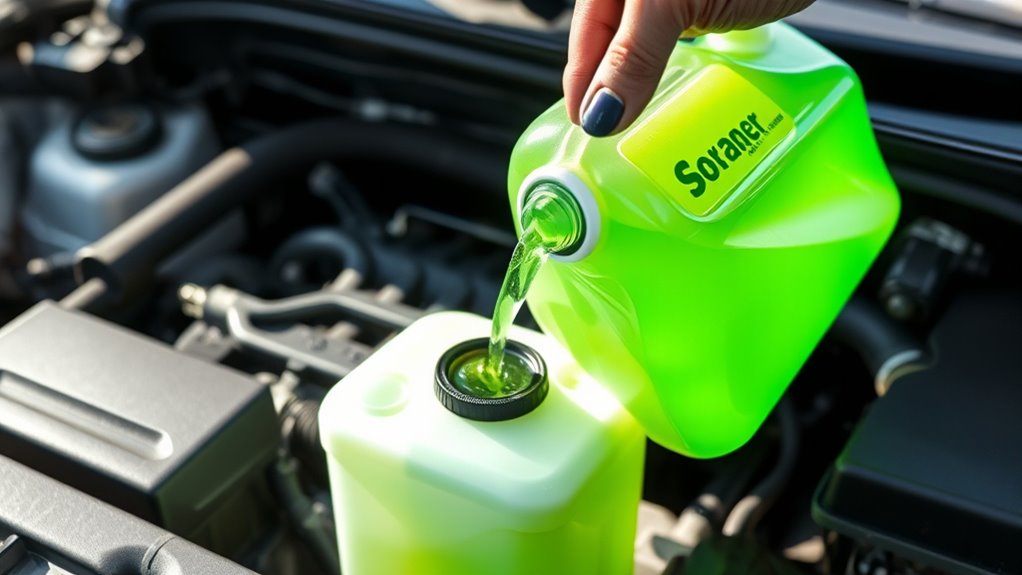
First, locate the coolant reservoir under your car’s hood and take a look at the current level. Just a heads up—make sure the engine is cool before you open the cap to avoid any burns. Once it’s safe, slowly pour the coolant into the reservoir until it reaches the recommended mark. Easy as that!
Locate Coolant Reservoir
Before you add engine coolant, you need to find the coolant reservoir under your car’s hood. It’s usually a translucent plastic tank, so you can check the coolant color without opening it. Identifying the reservoir correctly helps you avoid mixing different coolant types, which can affect coolant lifespan and engine performance.
Here’s how to locate it: Look near the radiator or engine block for a small tank with a screw or snap-on cap. Check for warning labels or symbols like a thermometer or “coolant” on the cap. Inspect the fluid inside; typical coolant colors include green, orange, pink, or yellow.
If you’re uncertain about the reservoir’s location or coolant specifications, consult your owner’s manual. Now that you’ve found the reservoir, you’re ready for the next step.
Check Coolant Level
How do you know when your engine coolant needs topping off? First, check the coolant level on the reservoir. Most reservoirs have “MIN” and “MAX” marks. Your coolant should be between these.
Also, observe the coolant color; it should be bright and consistent, which indicates good coolant lifespan. If it looks rusty or cloudy, it might be time for a change, not just a top-up.
| Coolant Color | Meaning |
|---|---|
| Bright green | Good condition |
| Pink or orange | Typically good |
| Cloudy or rusty | Old or contaminated |
| Clear | Incorrect or diluted |
Regularly inspecting ensures your engine runs cool and prevents overheating.
Pour Coolant Carefully
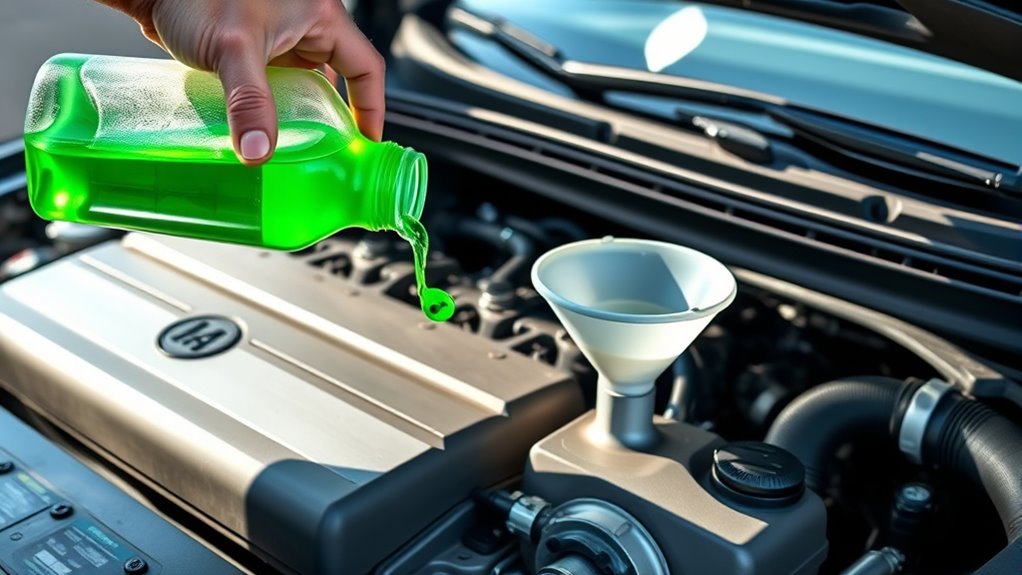
While the engine is cool, you’ll want to remove the reservoir cap slowly to release any built-up pressure. When pouring engine coolant, do it carefully to avoid spills and coolant contamination. Use a clean funnel to guarantee no dirt or debris enters the reservoir.
Here’s how to pour coolant properly:
- Pour steadily and avoid overfilling to prevent overflow.
- Use only the recommended coolant type for your vehicle.
- Avoid mixing old coolant with new to prevent contamination.
- Clean any spills immediately to protect engine components and the environment.
Checking For Leaks After Adding Coolant
Once you’ve added the coolant, you’ll want to check your car thoroughly for any leaks to assure the system is sealed properly. Start by inspecting around the radiator, hoses, and the coolant reservoir for any signs of dripping or wet spots.
Pay close attention to joints and clamps since those areas are common leak points. Understanding the coolant composition can help during leak detection. Many coolants contain dyes that make spotting leaks easier under UV light.
If you don’t have a UV light, look for discoloration or residue around connections. Also, check under the car for puddles or stains after running the engine for a few minutes. If you spot any leaks, address them immediately to avoid engine overheating or damage.
Performing this quick leak check ensures your cooling system maintains proper pressure and functions efficiently, keeping your engine safe on the road.
Resetting Your Car’s Coolant Warning Light (If Applicable)
After adding coolant and checking for leaks, you might notice your car’s coolant warning light still stays on. This happens because many vehicles require you to manually reset the warning light after coolant system maintenance. Resetting ensures your car accurately monitors engine coolant composition and system health.
To reset the coolant warning light, follow these steps:
Turn the ignition to the “ON” position without starting the engine. Locate the reset button on the dashboard or consult your owner’s manual for specific instructions.
Press and hold the reset button until the coolant light blinks or turns off. Then, start the engine and verify the warning light stays off, indicating a proper reset.
Frequently Asked Questions
Can I Use Tap Water Instead of Distilled Water With Coolant?
You shouldn’t use tap water instead of distilled water with coolant because tap water contains minerals that can cause corrosion and scale buildup.
For tap water alternatives, distilled or deionized water works best to maintain coolant compatibility and protect your engine.
If you’re in a pinch, bottled water labeled as purified can be a temporary option, but stick to distilled water whenever possible to guarantee your cooling system stays clean and efficient.
What Are the Symptoms of a Coolant System Failure?
About 30% of engine failures link to cooling system problems. You’ll notice coolant leaks under your car or a sweet smell inside.
Overheating issues are a major red flag. Your temperature gauge will spike, and steam might rise from the hood. Your engine might also run rough or stall.
If you spot these signs, don’t ignore them. Fixing coolant leaks and overheating problems quickly can save you from costly repairs.
How Often Should I Flush My Car’s Cooling System?
You should flush your car’s cooling system every 30,000 to 50,000 miles or as recommended by your vehicle’s manual. Different coolant types have specific lifespans, so always check what’s best for your car.
Following proper flushing procedures guarantees old coolant and contaminants are fully removed, preventing corrosion and overheating. If you’re unsure, let a mechanic handle the flush to keep your engine running smoothly and protect your cooling components.
Can Using the Wrong Coolant Damage My Engine?
Using the wrong coolant can be a bit of a party crasher for your engine. Different coolant types have unique chemical blends, and mixing them up might lead to less effective heat transfer or even corrosion.
This can sneakily contribute to engine overheating, putting your car at risk. To keep things running smoothly, stick with the coolant recommended for your vehicle. Your engine will thank you by staying cool and happy.
Is It Safe to Drive Immediately After Adding Coolant?
You shouldn’t drive immediately after adding coolant because the cooling system needs time to stabilize. After topping off, perform a cooling system inspection to check for leaks or air pockets.
Maintaining the correct coolant level is essential for preventing overheating. Let the engine cool down first, then start it and monitor the temperature gauge.
This way, you guarantee your car runs safely and efficiently without risking damage.
Conclusion
Now that you know how to gently refresh your car’s lifeblood, you’re all set to keep it running smoothly and avoid those unwelcome heat surprises. Taking a little time to check and add coolant isn’t just maintenance. It’s a small act of kindness to your engine.
Remember, a happy engine means a happier ride. So treat it well and enjoy the journey ahead with confidence and care by regularly adding engine coolant to your car.